Image



At Geofabrics, the Slopes & Walls team helps clients tackle some of the most challenging civil engineering projects across Australasia. We sat down with technical leaders, Eric Ewe and Jim Kounetas to hear their insights on slope stability, retaining walls, and practical solutions for safer, more resilient projects.

Can you tell us a bit about your role in the Slopes & Walls team?
Eric: I provide technical advice and pragmatic solutions to the design and construction of geogrid reinforced soil and mass gravity retaining wall systems. I also love educating engineers on Geofabrics solutions through webinars, in-house presentations and online meetings.
Jim: I oversee commercial sales and sub-contracting for slopes and walls projects, including the design, supply, and installation of retaining wall systems. My day-to-day includes supporting clients with practical, effective solutions for complex civil projects and sharing my experience from decades in construction to guide teams and contractors toward successful outcomes.
How did you get started in civil engineering and geosynthetics?
Eric: I started more than 28 years ago working for a design and construct contractor for slope reinstatement works using reinforced soil techniques in Malaysia. That’s where I developed my interest and passion for reinforced soil, slope stability engineering and retaining structures. I then moved to a geosynthetic material manufacturer and supplier, which gave me broader exposure to a range of geosynthetics and mesh products.
Jim: My career in civil engineering began over 34 years ago with Boral Masonry, where I worked in promotion, design, supply, and construction of segmental retaining walls. I later worked as an independent contractor until 2019, when I joined Geofabrics.
What are some of the most memorable projects you’ve worked on?
Eric: There are too many to mention, but generally, any successful solutions where we have provided value engineering or used the reinforced soil technology instead of conventional methods stand out.
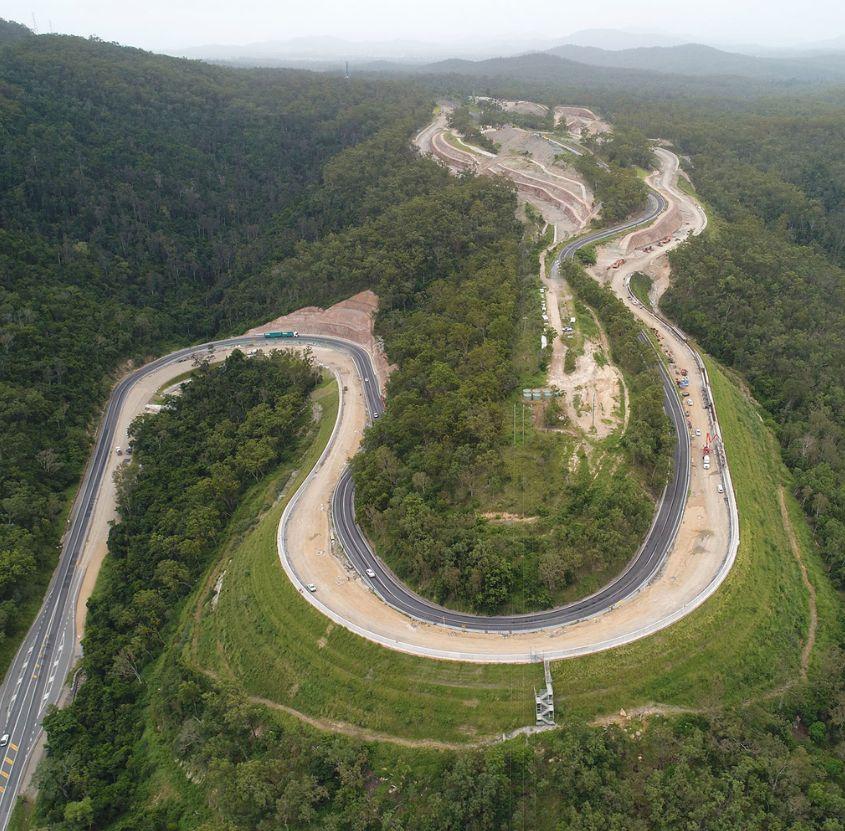
One example is the Eureka Bend slope reinstatement in New Zealand, where we worked closely with the consulting engineer and proposed a shored MSE wall as an alternative to the bridge and bulk earth filling. This solution helped the engineering firm win an innovation award.
What are the common challenges you see with slopes and retaining walls, and how do you approach them?
Eric: From my role as the Technical BDM, it’s about ensuring that our proposed solutions are both practical and reliable, while maintaining high standards of product quality and structural stability meeting the industry’s design guidelines. It’s a challenge I welcome, and I also enjoy helping clients understand the wall-facing options available to them, taking into factors like aesthetics, speed of installation, and suitable soil types, all of which affect the overall cost and performance of the structure.
Jim: Many slope stabilisation projects run into issues because soil variability is underestimated, the topography isn’t fully understood, or the effects of water, whether from rainfall, runoff, or the groundwater table are overlooked. A detailed soil investigation understanding the geological ground model and design scenarios considering the effects of water is required for a proper solution, usually based on stability analysis meeting the Factor of Safety (FoS).
How do geosynthetics improve slope and wall performance?
Eric: The inclusion of geosynthetics such as geogrid layers in compacted soil fill creates a composite soil block that is self-stable. This is known as reinforced soil or mechanically stabilised earth structure (MSE). This self-stable soil block becomes the stabilising soil mass that resists lateral earth pressures.
The geogrid-reinforced soil block is also ductile in nature, which is an important feature when dealing with unforeseen loading conditions, such as seismic load. There are many proven examples of reinforced soil structures performing well and surviving high-magnitude earthquakes in Japan, Taiwan and New Zealand.
Reinforced soil structures are also more tolerant of variations in foundation soil shear strength, allowing them to cope better with differential settlement. The overall pressure imposed on the foundation is more uniform than that of a rigid wall, making these structures more forgiving.
Q: What advice would you give engineers or contractors planning slope or wall projects?
Eric: Engineered slopes and walls are designed for a service life of 50 to 100 years. Their stability and performance are closely linked to the surrounding soils they retain and are founded on. Over their design life, these structures must withstand fluctuations in weather and other factors that affect soil properties. One of the most critical aspects is the correct specification of long-term effective soil parameters, which determines the overall factor of safety for failure mode checks. Careful attention to surface and internal drainage is also essential for ensuring the long-term performance of the structures.
Q: What’s the most rewarding part of your work?
Eric: It’s rewarding to see our technical advice implemented and know it plays a role in the long-term performance of the project.
Jim: The most rewarding part is seeing projects come together successfully, knowing that the solutions and guidance I’ve provided have helped deliver safe, efficient, and long-lasting retaining wall and slope outcomes for clients.
Our Slopes & Walls team is ready to share their expertise. Contact us for guidance and practical solutions tailored to your site.